
Maria Moor German-from-Russia Oral History, ca. 1980–1985
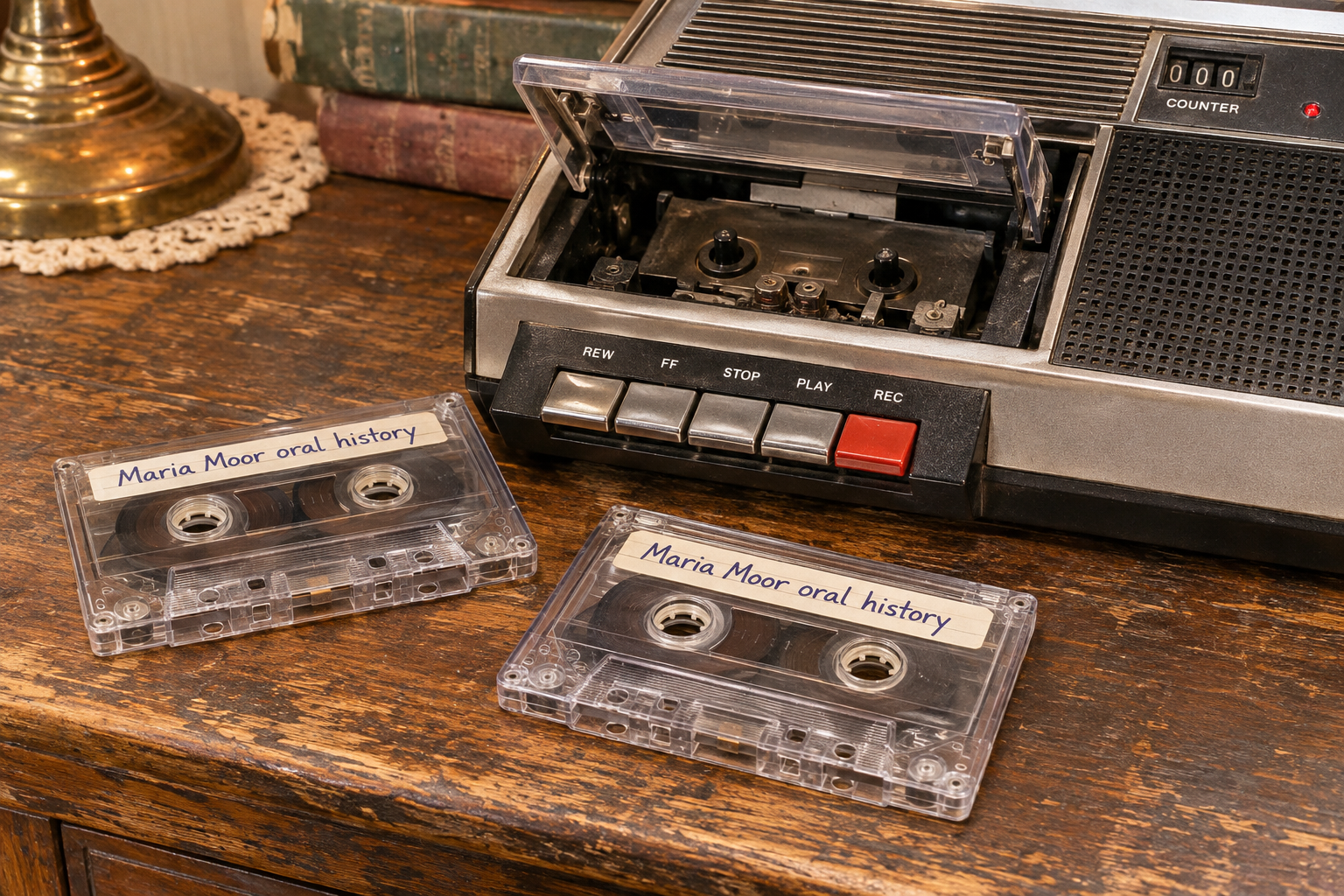
This collection holds two audio cassettes recorded in West Germany in the early 1980s, about 1 hour 21 minutes in all. Maria Moor and members of her family recorded them as a spoken letter to relatives living abroad. She was a German from Russia, born in 1916 in Ukraine. In their own words and in their Swabian German dialect, they describe what happened to the Volga and Black Sea German communities under Soviet rule.
Maria talks about the famine of 1933, when her father died on Christmas Eve and left seven children behind. She describes the 1941 deportation of all ethnic Germans to Siberia in cattle cars and the years of forced labor in the Urals for 600 grams of bread a day. Families were split apart for decades. After sixteen years she finally saw her mother again, and later her family made its long journey to resettle in Germany. She also recites poems she wrote about bread, longing, and the homeland. Other family members introduce themselves and send greetings. The tapes also include folk songs such as “Old Church Tower in the Home Valley” and “The Old Shepherd,” and a few political jokes from the Cold War era.
The cassettes were digitized by the West Nebraska Family Research & History Center in Scottsbluff. Each tape is provided with:
- the original audio, playable on the site
- a German transcript and an English translation as synchronized captions
- a name index of everyone mentioned, with links to the recording where they appear
A note on accuracy: the transcripts and translations were made with AI-assisted speech transcription and reviewed by WNFRHC staff. The speakers use regional dialect, and parts of the tapes are faint, so some words, names, and dates are uncertain and are marked with [?]. Researchers should confirm important details against the original audio.
Dating the recordings: No date was written on the cassettes, so the range ca. 1980–1985 is based on clues in the recordings:
Access to the audio and transcripts is available to NebraskaAncestors.org / WNFRHC members.
Clues that point to the estimation of the years of when the recording were made: From what’s in the transcripts, the best estimate is the early 1980s, so “ca. 1981” or “ca. 1980–1985” would be honest wording for the citation. These are the clues that point there:
- “Forty years” apart: on tape sides 1 and 3, Maria reads a poem saying she has lived apart from her brothers and sisters for forty years. She was deported in 1941, and forty years after that is about 1981. This is the strongest clue.
- Already settled in West Germany: the family has moved out of the Soviet Union to the Nuremberg area. On tape 1 she says they moved in 1962 and stayed there eight years, which puts the emigration around 1970 or later. On tape 2 someone says they’ve lived in their house for three years.
- A speaker born in 1947: on tape 2, a second speaker gives her birth date as February 21, 1947. She’d have been in her mid-30s around 1981.
- The Honecker jokes: Honecker ran East Germany from 1971 to 1989, so the recording is almost certainly from before 1989.
Some of these dates come from a garbled machine transcription, so it would be worth listening to the “forty years” poem and the 1947 birth date to confirm them. They’re near 14:55 on tape 3, and the 1947 date is on tape 2.
- Project Name: Maria Moor audio
- Project Manager: Floyd Smith III
- Project Status: Completed / Nov 2026
- Collection Donated by: Anonymous
- Project Statistics as of: 07 Nov 2026
4
Number of audio files (2 cassettes, 1 file per cassette side)
35
Number of Names Indexed
1:21
Total running time (hrs:min)
Source Information: NebraskaAncestors.org.
Maria Moor German-from-Russia Oral History Interview (ca. 1980-1985) and Name Index [online database]. © 2026 West Nebraska Family Research & History Center. Scottsbluff, Nebraska, USA. All rights reserved.
Original data: Maria Moor, oral history interview, four audio tapes (about 1 hr 21 min total), recorded ca.1981. WNFRHC Digital Archives, Oral Histories collection.
Transcripts, English translations, and the name index were produced with AI-assisted speech transcription (Grok) and reviewed by WNFRHC staff. Names and dates should be checked against the original recordings.
Browse and Search this collection:
M e m b e r s h i p R e q u i r e d T o A c c e s s T h e s e R e s o u r c e s
